
Watch the video version!
I had the tremendous honor of earning my Creative Writing MFA at Ohio State. That was such a special time for me, and no matter…whatever, I will always be grateful that I spent three years learning alongside top-flight writers and from top-flight instructors. One of the most helpful things about being in an MFA program (or any writing program) is that I had up-close and personal access to those instructors. I could read one of Erin McGraw’s stories and ask her why she structured a sentence the way she did. I could ask Lee K. Abbott why he chose a particularly musical phrase. Lee Martin why he chose to dramatize a particularly unsympathetic character. In this video, I am going to answer a question you didn’t ask and tell you why I began my YA novel My “I Want” Song the way that I did. (The book is available on Amazon, Nook, and Kobo!)
I wrote My “I Want” Song about five years ago after a little bit of a drought. I was a little…unhappy about…stuff…and fell in love with YA books. Looking for Alaska? What a great and honest book! With such compelling characters! Sarah Dessen? What a fun author. And she cranks out a bestseller every year like clockwork. Grr…
The book draws quite heavily on my own experiences doing two high school musicals when I was young. The pitch is pretty simple: It’s the last week before the big high school musical. Future playwright Seren Bennett helps her friends solve their own problems, but the biggest and last bit of drama…obviously…is that she confronts her own big problem.
Seren is the first-person protagonist, so she does all of my work for me. She introduces the character, moves the plot…everything. It’s great. The structure of the book is also relatively simple. Each chapter is a day before opening night, and each day has a big conflict. So I wondered: where to begin? Well, Opening Night is a Friday, so it had to be the previous Friday. (I wanted to make sure I had a weekend in there so we could see the characters at leisure.)
I wanted to open with the characters onstage and with a moment of great drama. It also needed to be a moment that was of significance to the protagonist. Otherwise, why would the moment be memorable for her? So let’s check out what I did:
Come on. At the very least, this is fun. Seren is experiencing her first kiss. Sure, it’s on stage, and the guy in question is doing what he’s told by the script, but it is a kiss nonetheless. I also liked the idea of doing a little bit of a fakeout. While Seren is thinking about the kiss in selfish terms, I spend the first whole page fibbing to the audience. Seren and Tomas are reciting lines; they’re not speaking honestly to each other.
Now, there’s nothing inherently wrong with beginning in medias res (in the middle of things) or beginning a creative work in something other than reality. I had a responsibility to ensure, however, that the reader knew very clearly that I was fibbing. That’s why I broke the kiss scene with Ms. Robey literally shouting “Cut!” and speaking about the next scene.

The writer leads the reader along. We can take them anywhere. We just need to make sure that we do so clearly and fairly. Speaking of which, I knew I needed to explain what an “I Want” song is. That’s why I spend time on the next page describing what that means and doing so in Seren’s voice using references Seren would use.
The rest of the first section consists of something that scares me: no action.


I will admit that I’m a cinematic prose stylist and I like stories in which things happen and I sometimes have little time for stories in which nothing happens. So I took the liberty of spending a whole page allowing Seren to soliloquize, to speak directly to the audience…but then I break into a new section and go right back into the dramatic present.
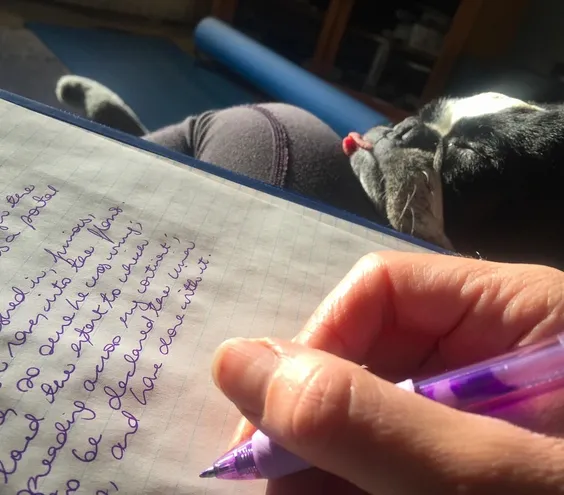
It’s definitely hard to go back in time and remember every second in which I was scribbling longhand into a notebook I thought Seren might use. But I’ve been writing long enough that I can definitely articulate why I made these choices.
- I wanted to begin in the dramatic present on a moment that was meaningful for Seren. Boom. First kiss.
- I wanted to introduce the conceit of the story—this is the week before Opening Night—so I started in rehearsal.
- I needed Seren to explain the title a little.
- I wanted to let Seren, a future famous playwright, to do a bit of a monologue.
- I wanted to get back into the dramatic present as quickly as possible.
You be the judge. Did I succeed? What are your concerns when you start your own stories?

